HMCS Kingston and HMCS Glace Bay off on Great lakes Tour

Her Majesty’s Canadian (HMC) Ships Glace Bay and Kingston departed Halifax today to conduct a seven-week period of coastal operations and training exercises until the end of July. As part of their deployment, these two Kingston-class Maritime Coastal Defence Vessels, and the Naval Reservists who crew them, will visit various ports of call along the St. Lawrence Seaway and the Great Lakes, providing Canadians with opportunities to tour the warships and interact with their crews.

In between port visits, HMC Ships Glace Bay and Kingston will conduct various coastal operations and training exercises to maintain operational readiness to deploy on joint operations at home and abroad. This tour will also provide opportunities to inform and educate Canadians about how the Naval Reserve contributes to the protection and security of our maritime waters and approaches by working with our allies and other government partners in maritime security.

HMC Ships Glace Bay and Kingston will sail from Halifax through the St. Lawrence Seaway starting today and returning to Halifax at the end of July. During the tour, Glace Bay and Kingston will visit the following ports of call:

– Sydney, Nova Scotia, June 14-17;
– Chicoutimi, Quebec, June 20-23;
– Toronto, Ontario, June 28 – July 2;
– Oshawa, Ontario, July 5-8;
– Port Colborne, Ontario, July 12-14; and
– Kingston, Ontario, July 12-15.

HMC Ships Glace Bay and Kingston have participated in a number of exercises and operations including their most recent participation in the campaign against illicit drug trafficking in the Caribbean as part of Operation Caribbe in 2012.

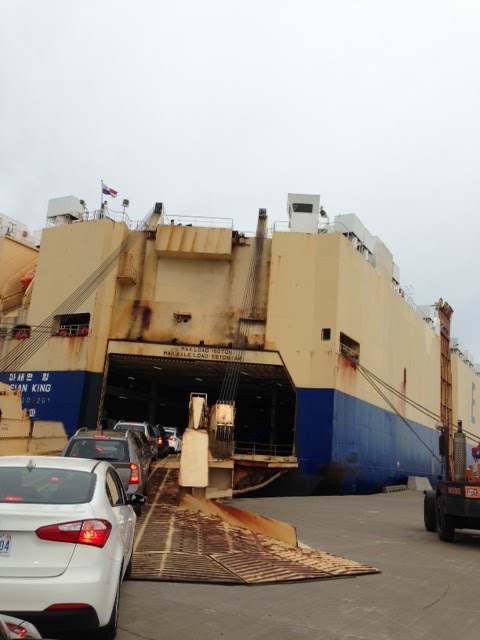
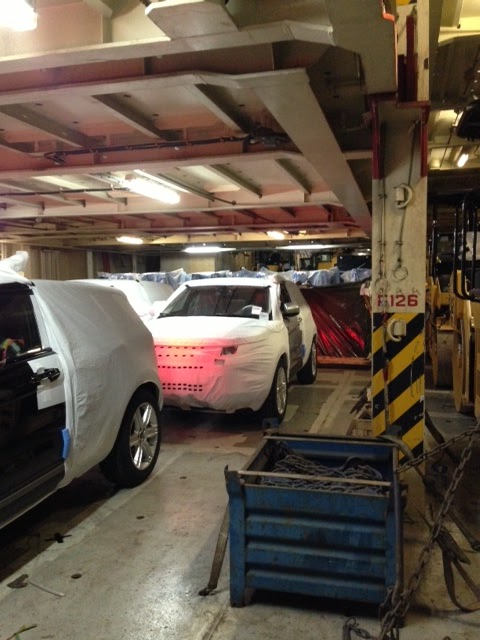
Inside the Asian King

 The PCTC Asia King Put into Halifax today, and tied up at Autoport. The Follwoing photos were sent to me by a reader, of the Inside of Her.

(Above) moveable ramp (below) bulk cargo

(above and below) Maserati

 (Above) Line up to board (below) parking

(Below) More then just cars, Also Heavy equipment.

Coast for Melfi

The Container Vessel Coast called over the wekend for Melfi. She spent Saturday at anchor in the basin, presumably waiting out weather. She moved to Pier 41 Sunday morning, and is still there, though she has appears to have completed cargo Operations

Back Fishing

After a Weeklong layup in port last week, the fishing fleet departed for the  grounds yesterday at noon. Some vessels eturned to offload catch, before heading out to sea again.

The Processors are offloading at Pier 9 this year.

Another Early G6 vessel – Dalian Express

Another Hapag Lloyd vessel Scheduled for the upcoming G6 Rotation, Dalian Express will be making her second trip to Halifax. She was last here on May 27th, and has since turned and is making the trip back in reverse. Like G6 service Mate Yantain Express, who stopped in halifax earlier in May,  Hapag Llyod is in the process of reshufeling vessels to accomidate new builds and the new g6 service.

Photos to Follow

Riverton Puts in

Over the Lunch Hour, the supply Vessel Riverton Put into Halifax. Riverton is currently woirking for shell on their offshore exploration off Nova Scotia, and is shuttleing supplies back and forth from the siesmic vessles.

USCGC Morro Bay for a visit.

USCGC Morro Bay is a Bay Class Icebreaker, Homeported in New London, CT. She is 140′ long, ans was built in 1981. She arrived Saturday for a visit, and will be departing tommorow, June 4th. Unlike Most USCG vessels visiting, she is tied up at Tall Ships Quay, and not at the dockyard.
 
Bay Class vessels are stationed mainly in Northeast U.S. and Great Lakes. Although specifically desinged for ice breaking duties, they also perform law enforcement, environmental protection, search & rescue operations and support for aids to navigation activities.

WTGBs use a low-pressure-air hull lubrication or bubbler system that forces air and water between the hull and ice. This system improves icebreaking capabilities by reducing resistance against the hull, reducing horsepower requirements.

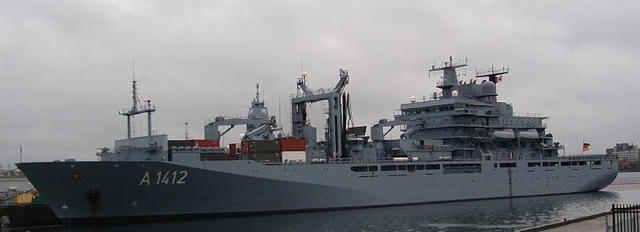
New support ships to be German Berlin Class

The Government of Canada today announced that a ship design for the Joint Support Ships being acquired for the Royal Canadian Navy has been selected, as part of the National Shipbuilding Procurement Strategy.

The selection of the Joint Support Ship design was conducted through a transparent assessment process, involving multiple government departments and third party advisors, based on three criteria: operational capability, affordability, and the cost and schedule risks associated with building the ship. The process was monitored by audit firm KPMG, as an independent third-party. First Marine International, a recognized firm of shipbuilding experts, provided ship construction costing expertise. 

Two viable ship design options were commissioned for the Joint Support Ships: an existing design and a new design by BMT Fleet Technology. Based on rigorous analysis and assessments by government officials and military experts, the proven, off-the-shelf ship design from ThyssenKrupp Marine Systems Canada was selected as the best design option for the Royal Canadian Navy and for Canadian taxpayers.

Canada will provide the design to Vancouver Shipyards Co. Ltd, to review in preparation for actual production. This design development work will be led by Vancouver Shipyards Co. Ltd., as part of the Joint Support Ship definition contract to be negotiated between Canada and the shipyard. Once these steps are completed, Canada will acquire the required licensing for the ship design. This license will enable Canada to use the ship design and build, operate, and maintain the Joint Support Ships – right in here in Canada. This effort will also enhance technical skills and knowledge among Canadian shipyard staff, to be leveraged as the shipyard builds the subsequent ships assigned under the National Shipbuilding Procurement Strategy.

The Joint Support Ships, which will be built by workers at Vancouver Shipyards Co. Ltd, will supply deployed Naval Task Groups with fuel, ammunition, spare parts, food and water. They will also provide a home base for maintenance and operation of helicopters, a limited sealift capability, and support to forces deployed ashore.