Onego Trader

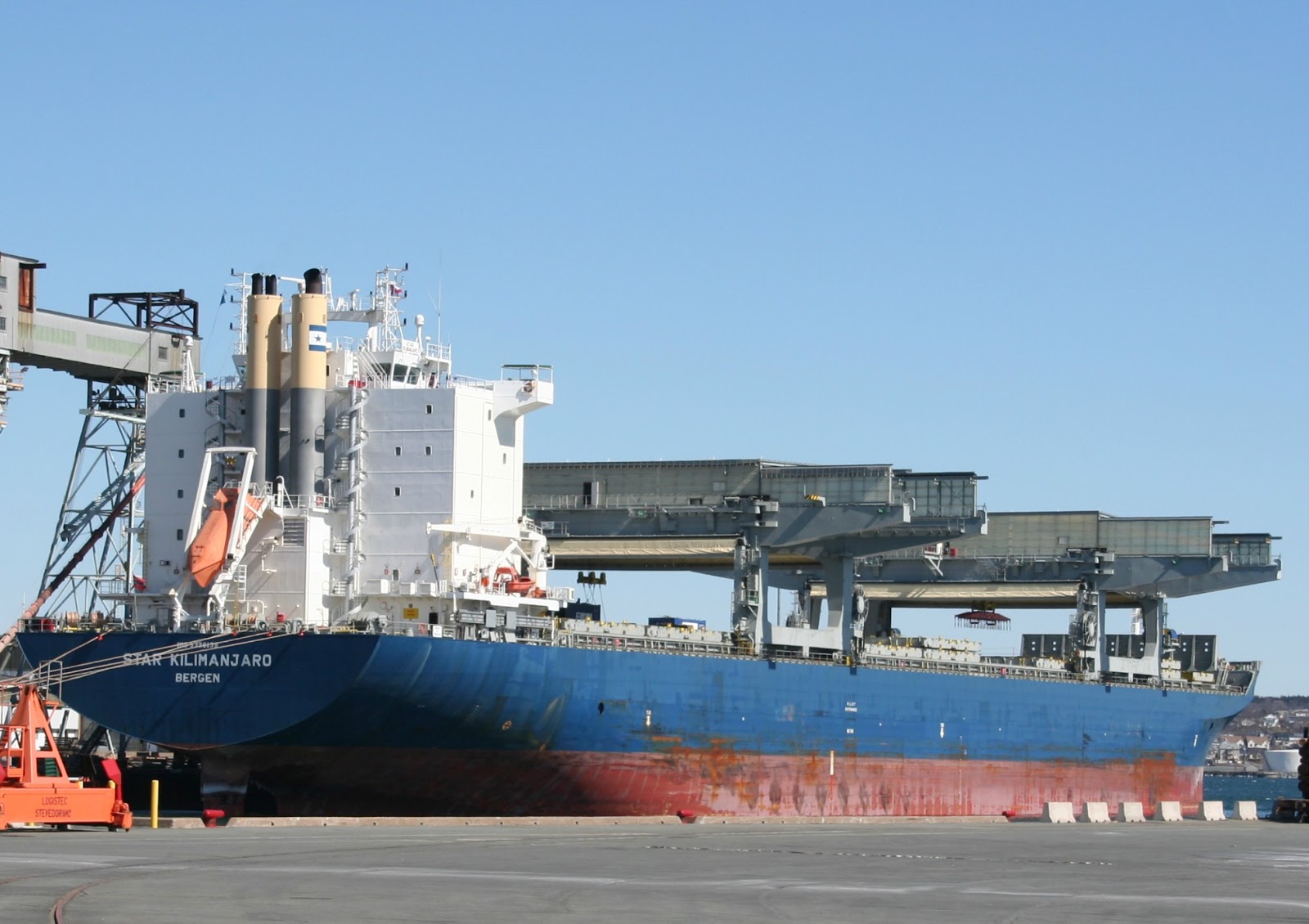
Onego Trader at Pier 31. As a general cargo vessel, she can carry bulk, break bulk and container cargos. Dutch Registered, shes 132m long, and comes in at 8800dwt.

Onego vessels are fairly regular callers to Halifax, though not on a scheduled service.

Zim backup

Zim Barcelona is currently anchored off pier42 mostly empty. Zim Rio Grande is currently in the outer anchorages. Zim Barcelona departed pier 41 earlier but was unable to sail due to high seas and wind shutting down pilotage operations. Zim rio grande is unable to enter for the same reason.

One vessel did enter port. The offshore tug Ryan Leat has a pilotage exemption

Naval Ship Updates

 (Above)HMCS Halifax having addtional Kit Fited as the final phases of the FELEX Refit are underway.

(Left) Front on view of HMCS Fredericton, the second vessel to leave the shipyard.

(Bottom)HMCS Athabaskan finishing her 5 year work period at the dockyard.

Contracts Signed for Final AOPS Design

The Honourable Rona Ambrose, Minister of Public Works and Government Services and Minister for Status of Women, along with the Honourable Peter MacKay, Minister of National Defence, and the Honourable Kerry-Lynne D. Findlay, Associate Minister of National Defence, today welcomed the signing of the definition contract with Irving Shipbuilding Inc. for the Arctic/Offshore patrol ships project through the National Shipbuilding Procurement Strategy (NSPS) at an announcement at halifax Shipyards.

This is the next contract signed after the ancillary one announced in July 2012 and it will be followed by a construction contract in 2015. This definition contract is a task-based contract divided into seven work packages (or tasks) that could be awarded. With this contract, Irving Shipbuilding Inc. will refine and complete the Arctic/Offshore patrol ships design to production level prior to construction in 2015. The total potential value of the contract is an estimated $288 million and it will support up to 200 jobs.

Once completed, the definition contract will enable Irving Shipbuilding Inc. to know exactly what to build and how to build it. It will ensure that once the build contract is signed, construction of the ships will begin.  At the same time, work will begin on improving and upgrading the Irving Shipyard to begin full ship construction in 2015.

During the initial discussions regarding the Navy’s Arctic/Offshore patrol ships, Canada and Irving Shipbuilding Inc. agreed that the first contract should be a smaller preliminary contract, followed by a larger definition contract to complete the Arctic/Offshore patrol ships design to production level, and subsequently an implementation contract to build and deliver the ships.

This “design-then-build” approach will mitigate both technical and cost risks by reducing unknowns, and therefore risks, for the building phase. Once completed, the definition contract will enable Irving Shipbuilding Inc. to know exactly what to build and how to build it. It will ensure that once the build contract is signed, construction of the ships will begin immediately. This approach is also aligned with the NSPS, which is built upon a more collaborative and risk-sharing relationship.

On July 10, 2012, the Government announced the awarding of a $9.3-million (HST included) preliminary contract to Irving Shipbuilding Inc. Within this preliminary contract, Irving Shipbuilding Inc. reviewed the existing Canadian-developed Arctic/Offshore patrol ships design and specifications, prepared an execution strategy and delivered a proposal detailing the scope and cost of the subsequent definition contract.

Finally, on March 7, a definition contract with Irving Shipbuilding Inc. was signed. The total potential value of the contract is an estimated $288 million (taxes included). The definition contract is a task-based contract divided into seven work packages (or tasks) that could be awarded. The first two tasks have been authorized and their total value is approximately $136 million.
The definition contract will last 30 months and we are on track to start cutting steel in 2015.
The Arctic/Offshore patrol ships will be used by National Defence to conduct armed seaborne surveillance in Canada’s economic exclusion zone, including in the Arctic.

The definition contract signed with Irving Shipbuilding Inc. is a task-based contract divided into the following seven work packages (or tasks) that could be awarded. With this contract, Irving Shipbuilding Inc. will refine and complete the Arctic/Offshore patrol ships design to production level prior to construction in 2015.

  1. Project Management – This task will include all work required to ensure effective planning, management, execution, monitoring and control, and reporting of the definition contract work.
  2. Engineering Design Phase 1 – This task will include the system engineering activities, integrated logistical support analysis and supplier engagement activities that are necessary to demonstrate that the preliminary Arctic/Offshore patrol ship design meets all of the contract design specification requirements with acceptable risk and within the cost and schedule constraints.
  3. Engineering Design Phase 2 – This task will include the system engineering activities, integrated logistical support analysis and supplier engagement activities that are necessary to demonstrate that the Arctic/Offshore patrol ship design is a complete and integrated solution that meets all the contract design specification requirements with acceptable risk and within the cost and schedule constraints.
  4. Engineering Design Phase 3 – This task will include the system engineering activities, integrated logistic support analysis and supplier engagement activities that are necessary to demonstrate that the Arctic/Offshore patrol ship design is a complete and integrated solution that meets all of the contract design specification requirements and is ready for the start of vessel construction.
  5. Project Implementation Proposal Development – This task will encompass all the procurement, engineering, production and estimating activities required to develop the detailed project implementation proposal, including the required plans and a substantive cost for the implementation contract.
  6. Test Production Module – This task will include all the work required to establish and verify production processes and produce a test module prior to beginning vessel construction.
  7. Long Lead Items Procurement – This task will encompass all of the procurement and supply chain activities required to procure long lead items, which must be purchased prior to the start of vessel construction.

Once completed, the definition contract will enable Irving Shipbuilding Inc. to know exactly what to build and how to build it. It will ensure that once the build contract is signed, construction of the ships will begin.

HMCS Sackville gets Federal Money

Minister MacKay announced a one-time government contribution of $240 000 to the Canadian Naval Memorial Trust in support of the naval memorial HMCS Sackville, and the Canadian Naval Memorial Project. Further, on behalf of the Honourable Rona Ambrose, Minister of Public Works and Government Services and Minister for Status of Women, announced a contract award of $455 400 to Akoostix Inc. for a Sonar Processor.

Minister MacKay took the opportunity to announce the contribution of $240 000 in support of the naval memorial HMCS Sackville, and the Canadian Naval Memorial Project.

“HMCS Sackville is a witness to our past and reminds us of our Navy’s accomplishments during the Battle of the Atlantic,” said Minister MacKay. “Canadians can be proud of our Navy’s rich heritage and our contribution to preserve the vessel for the benefit of future generations.”

“The young men who sailed in the North Atlantic on corvettes like Sackville proved critical to victory in the Battle of the Atlantic, which was the key campaign of the Second World War,” said Vice-Admiral Paul Maddison, Commander Royal Canadian Navy. “I am extremely pleased that the Government of Canada is contributing to the Canadian Naval Memorial Project.”

The Canadian Naval Memorial Trust was formed in 1982 by a group of retired Royal Canadian Navy (RCN) members who sought a forum through which they could preserve, in a living fashion, the history of the Royal Canadian Navy (RCN). In 1985, the Government of Canada designated Her Majesty’s Canadian Ship (HMCS)Sackville as Canada’s official naval memorial, dedicated to telling the story of the RCN and to preserving Canada’s naval wartime heritage. The Canadian Naval Memorial Trust operates HMCS Sackville as a living memorial and interpretation centre, which depicts the life of Canadian sailors who served in the RCN to keep the sea lanes between Europe and North America open during the Second World War.

Despite efforts at ongoing maintenance and support, weathering and the environment contributes to the continued deterioration of the ship. Over the past 10 years, this deterioration has intensified and the Trust has indicated that the long-term preservation of the Sackville can only be assured if the vessel is placed in an environmentally controlled berthing facility that is free from corrosive elements.

To that end, the Trust embarked upon the Naval Memorial Project, which seeks to construct a Naval Memorial Centre on the waterfront in Halifax, Nova Scotia with funding coming from private donations and other levels of government. The Naval Memorial Centre will house HMCS Sackville in a berthing facility that is publically accessible and yet protects the ship from continued environmental degradation. The $240,000 contribution from the Department of National Defence will support the Trust’s funding needs for the design of the Naval Memorial Project building(s).

The Naval Memorial Project will ensure the preservation of HMCS Sackville so that she may continue to serve as a reminder of the sacrifice of so many Canadians who died on the seas defending the freedoms that Canadians today enjoy.

The CNMT was formed with a mandate to preserve the Second World War era Flower-class corvette as a Naval Memorial and museum, providing professional interpretation of the ship within the larger scope of the Royal Canadian Navy’s own history.

Louis St Laurent Arrives in Halifax

The CCGS Louis St Laurent arrived in Halifax. and tied up at the Coast Guard Base in Dartmouth.
She damaged her bow in a Colision with the Maple Lea.

Photos to follow. 
(Below) looks like a patch was applied in Sydney. This was likely to keep the water out in an area where the hull was breached. The remaining damage looks to be to the deck railing.

Related Posts Plugin for WordPress, Blogger...