
Captain James Cook

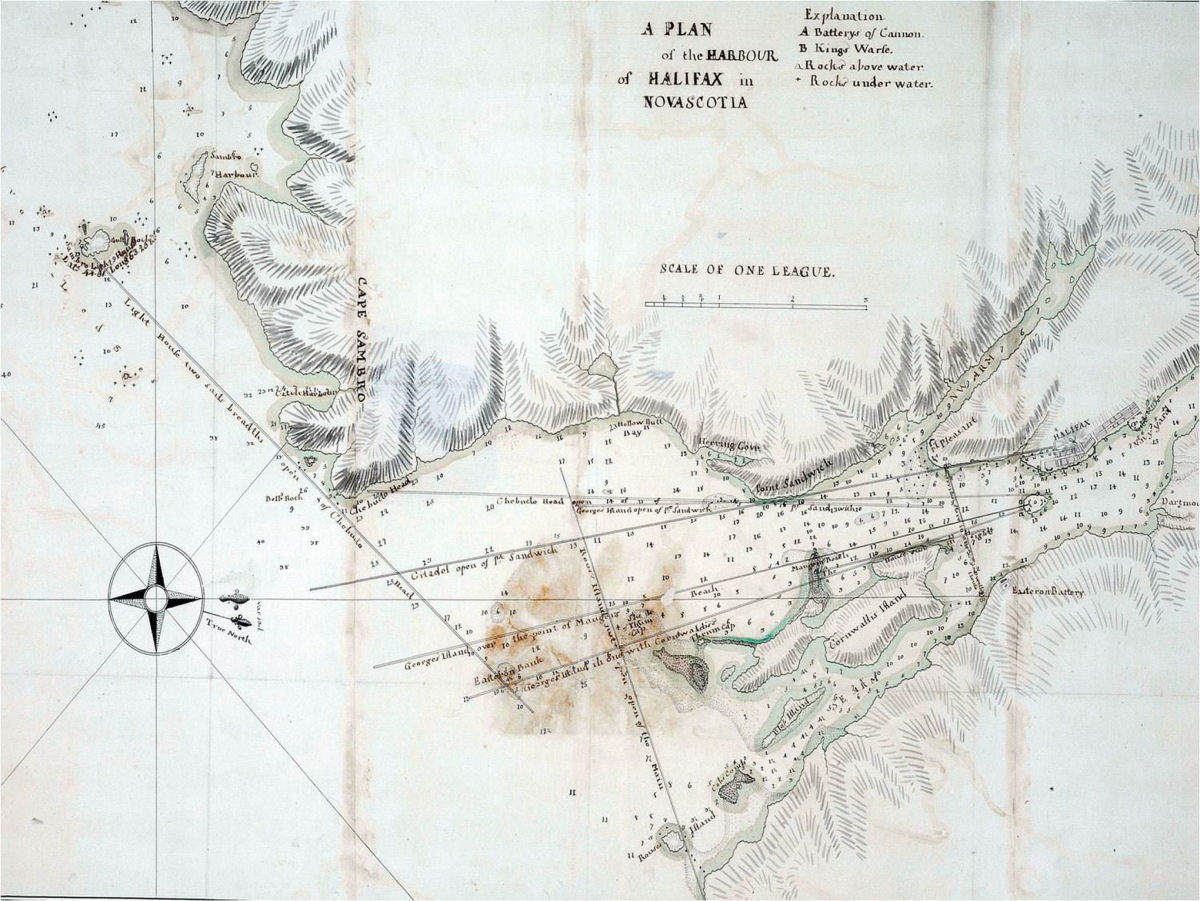
Captain James Cook, was a British explorer, navigator, cartographer, and captain in the Royal Navy. He was Killed by Natives on the island of Kona Hawaii, 234 years ago today. Why do we care about James Cook? He was responsible for the earliest charts of much of the east coast of Canada including Halifax – His chart of which is below.
 

From Wikipedia:

During the Seven Years’ War, he served in North America as master of Pembroke. In 1758, he took part in the major amphibious assault that captured the Fortress of Louisbourg from the French, after which he participated in the siege of Quebec City and then the Battle of the Plains of Abraham in 1759. He showed a talent for surveying and cartography, and was responsible for mapping much of the entrance to the Saint Lawrence River during the siege, thus allowing General Wolfe to make his famous stealth attack on the Plains of Abraham.

Cook’s aptitude for surveying was put to good use mapping the jagged coast of Newfoundland in the 1760s, aboard HMS Grenville. He surveyed the northwest stretch in 1763 and 1764, the south coast between the Burin Peninsula and Cape Ray in 1765 and 1766, and the west coast in 1767. At this time Cook employed local pilots to point out the “rocks and hidden dangers” along the south and west coasts. During the 1765 season, four pilots were engaged at 4 shillings a day each: John Beck for the coast west of “Great St. Lawrence”, Morgan Snook for Fortune Bay, John Dawson for Connaigre and Hermitage Bay, and John Peck for the “Bay of Despair.”

His five seasons in Newfoundland produced the first large-scale and accurate maps of the island’s coasts and were the first scientific, large scale, hydrographic surveys to use precise triangulation to establish land outlines. They also gave Cook his mastery of practical surveying, achieved under often adverse conditions, and brought him to the attention of the Admiralty and Royal Society at a crucial moment both in his career and in the direction of British overseas discovery. Cook’s map would be used into the 20th century—copies of it being referenced by those sailing Newfoundland’s waters for 200 years.

Bounty Hearings

THE USCG is holding hearings today into the sinking of the Bounty. Our coverage of the Bounty Sinking can be found in our first post and Second Post.

The Chronical Hearld has the following stories:
Horrific last moments for Bounty victims
Christian family seeks truth

And will be Live Blogging via  Bounty captain’s competency at issue in Coast Guard hearing
Updates Below are based on that live blogging, and may be incomplete. G-Captain has a reporter at the hearings, and I will provide links to thier summary as well.

 UpdatesTestimony Day 1:
Chief Mate Testimony indicates that the Ships Stability Letter was not Followed/Accurate,and that bilges required regular pumping- once or twice every 4 hours. Modifications were made to the ship moving fuel tanks, and structure Aft during September/October refit, as well as replacing some above waterline planks. She also carried addtional lead balast aft.

On the 28th, making 10 knots, twice normal speed. sail damaged by wind, and is fureled. around 4pm, port fuel tank glass breaks, spilling fuel, port engine and generator go down. pumps running continuously, dirt and dust is accumulating in filters. Lack or port generator lead t ofuel starvation of starboard engine.

water was coming in between planks above waterline port side by main and mizzen masts, above engine and tank rooms. Imersion suits were put on when water was between decks. The ship rolled, and most were thrown off. Seas were 28feet, wind 40knots at time of capsizing.

G-Captain has a good summary of the days testimony.

Day 2
Today will feature a woman from the bounty office, as well as a representive of the shipyard who did work on the bounty before she sailed.

The bounties director of shoreside operations basically testified that. The ship was not a passenger vessel and only crew sailed aboard her. Bounty was surveyed in 2012 for the insurance company. The bounty had o written procedures, and most details of the ships operation were left up to the captain.

After a cg inspector who inspected the tank work testified. He declined to perform a full hull inspection as one was not required until 2015.

Next up was the director of Tallships America. He testified that walridge was competent, but he would not have sailed in those conditions.

Finallay a project manager from boothbay harbour shipyard testified. He stated and provided photos showing significant deterioration of hull frames and wet rotten and mouldy wood. O repairs were made and additional work would be done the next year. He advised walbridge not to sail in heavy weather. The bad areas were only 6 years old indicating a poorly executed repair at the booth bay yard.

Day 2 coverage via gCaptain

Day 3
The first witness of the day was an expert in measuring ships. he covered the issue of the Vessels tonnage certificate. Basically the rules for measuring the volume within the ship. with the staircase removed, the ship was over 300tons, and would require a load line certificate, which would require her to undergo a more stringant examination, and require all defcencies to be repaired. with the stair in place, the bounty was 266tons, and was clear.

 Day 3 also brought the testimony of the former Bothbay shipyard manager. He testified that there was damage, however he had seen much worse, and felt the repairs were sufficient. Having worked with woodenships fro the previous 40 years, he had been involved with the 2001 reft where thebellow waterline planking was replaced with oak, and the 2007 refit, where the above waterline planking was replaced with fir.

The Last witness of the Day was the bountys marine surveyor, and Naval architect. he testified that he designed the pump system, and survyed it, he was also friends with captain wallbridge, and they spoke frequently. He felt he was not in a conflict of interest. He was requested to perform a survey for the insurance company. He spent a day onboard, and did a cursory inspection, and testified he would need to do more, but it is unclear if he ever communicated this with anyone.

Day 3 Coverage at gCaptain

Truck Flip at Halterm

Yesterday there reports of a Truck rolling over at Halterm. The driver was ok. And no other details were provided.

I Have since learned that one of the twist locks broke off the spreader on Crane 4 (the one closest to pier 36), releasing the container from one end 8 ft high and the rest fell. The container hit the chassis on its side, and rolled the chassis and tractor over.

More halterm crane details

We previously reported that halterms new cranes were scheduled to ship on June 8. We now know they will be delivered by ZPMC’s vessel “Zhenhua 19” registered in Saint Vincent and the Grenadines.

The information is contained in an application for a coasting trade licence to allow the vessel to
be used to reposition the old smaller gantry crane from pier 42 to pier 36 at the Halterm. This confirms the fate of the crane at pier 42, Which would have been in the way, and would need to be moved or scrapped.

 We also now know that the cranes are due July 15, based on the dates provided in the Costing licence Application.

CCG Announces the Acceptance of the CCGS Corporal Teather C.V.

The Honourable Keith Ashfield, Minister of Fisheries and Oceans and Minister responsible for the Atlantic Gateway, announced the acceptance of the the third of the Canadian Coast Guard’s new Hero Class vessels, the CCGS Corporal Teather C.V., built by Irving Shipbuilding Inc.

“Our Government is proud to name our ships built in Canada after Canadian heroes,” said Minister Ashfield. “Not only does their construction support job creation and local business, once in action, the CCGS Corporal Teather C.V. will enhancemaritime security along the Great Lakes and the St. Lawrence Seaway.”

CCGS Corporal Teather C.V. was named after Corporal Robert Gordon Teather, C.V., a member of the Royal Canadian Mounted Police diving team in Surrey, British Columbia. Corporal Teather rescued two fishermen trapped in the hull of their capsized boat. This heroic rescue occurred in the early morning hours of September 26, 1981. Corporal Teather passed away November 14, 2004. For his actions Corporal Teather was awarded the Cross of Valour.

The Hero Class vessels are named for decorated soldiers, veterans and police officers as well as employees of Fisheries and Oceans Canada and the Canadian Coast Guard. By naming these after Canadian heroes the Government of Canada hopes to encourage future generations to learn about Canadian history, culture and geography.

The Hero Class vessels are 47 metres in length with a displacement of 257 tonnes and a top speed of 25 knots.

The CCGS Corporal Teather C.V. will be based in Central and Arctic Region where it will enhance maritime security along the Great Lakes – St. Lawrence Seaway system. A formal naming and dedication ceremony will follow when the vessel makes its way to its home region.