Category Archives: history

Halifax Shipyard’s Graving Dock now a National Historic Civil Engineering Site

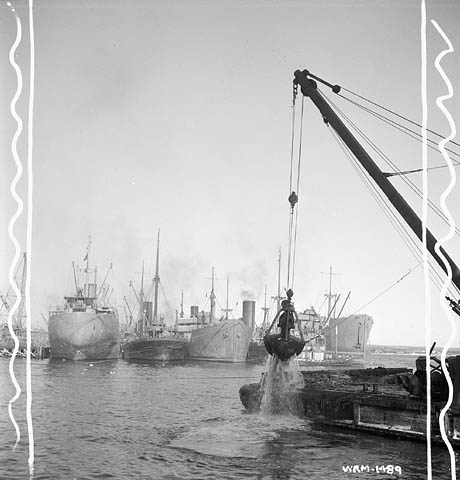
Today the Canadian Society for Civil Engineering (CSCE) officially designated the Halifax Shipyard’s Graving Dock as a National Historic Civil Engineering Site. Now owned by Irving Shipbuilding, the large dry dock was constructed in the 1880s for shipbuilding and repairs. It has functioned during two World Wars and is still serving the industry today. According to the CSCE’s Program of Designation, the 173-metre-long and 24-metre-wide graving dock is a remarkable engineering accomplishment: at 125 years old it is still performing, essentially according to its original design. At the time of its construction, it was the largest dry dock on the Eastern Seaboard and could handle the world’s largest vessels.

The Graving Dock remains a critical part of Irving Shipbuilding’s operation to this day.  Currently in dock is HMCS St. John’s, one of the Canadian Navy’s Halifax-Class frigates.  Originally Irving-built at Saint John Shipbuilding, seven of these ships are now in the midst of a refit program.  It can take anywhere from 12 – 18 months to complete each ship.  The program began in 2011 and will continue into 2017.

It is fitting that the Graving Dock has been recognized for its significance from a historical civil engineering stand-point.  It has survived the Halifax Explosion, several World Wars, and the inevitable advancement of the industry from wooden to steel ships as well as the exponential growth in vessel size and weight.  It helped repair several thousand ships during World War II and now is the repair site for our Navy’s current combatant fleet, in the very shipyard that will construct the Navy’s new combatant fleet beginning in 2015.

The Ocean terminals At pier 20 are also Registered as a National Historic Civil Engineering Site
HMCS Sackville – A Night Of Furious Action

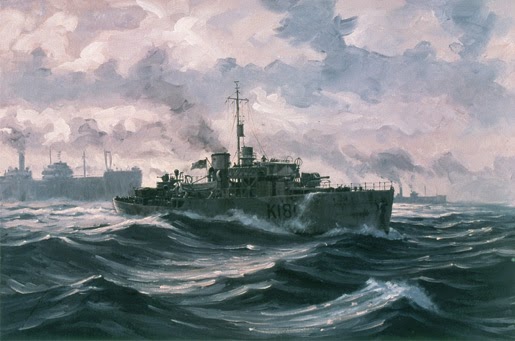
Marc Milner is one of Canada’s preeminent naval historians and expert on  the corvette. I suggest taking look at has recent article A Night Of Furious Action at http://legionmagazine.com. This Piece looks at the work of Escort Group C3, Protecting convoy ON 115 from July 29 to Aug. 1, 1942

Marc has also Produced a number of Books, Including Corvettes of the Royal Canadian Navy: 1939-1945 which is the best guide to the Canadian Corvettes.
Painting Above- JOHN M. HORTON, BEAVERBROOK COLLECTION OF WAR ART/CANADIAN WAR MUSEUM—19840654-001

The Canadian Naval review on Shipnames.

With the Recent announcement of names for the Joint Support Ships, commemorating battles during the war of 1812- The Government both Kept and broke with tradition. Both vessels are named for Canadian Places, though are new names, not used in the past. traditionally Battle Honours are bestowed on vessels as rewards for”the achievements and sacrifices of naval personnel in defense of this country and our allies”

The naval review brings up the point “That in 1917/18 the navy named the Battle-class trawlers for selected First World War army battles, e.g. HMCS Vimy.  This time frame, however, was before the award of army Battle Honours”

The author, David Freeman wonders why not commemorate vessels with Battle honors; Camrose, Lunenburg, Prescott, Port Colborne and Woodstock all have 5 honors each, and the names are not currently in use. There are a number of vessels with 4honors – Kitchener and Stormont; 3 honors – Alberni, Baddeck, Drumheller, Georgian, Grou, MataneMimico, Moose Jaw, Parrsboro, Rimouski and Ste. Therese.

Hopefully when it comes time to name the 6 AOPS, some of these vessels names will be reused.


I am aware of 3 surviving Canadian WWII Ships with Honors.
HMCS Sackville holds 1 battle honor.
HMCS Haida Holds 5, Spaning 2 conflicts.

HMCS Stormont (Noted above with 5) was converted into a yacht by Aristotle Onassis

Thomas Harold Beament; Artist and Naval Officer

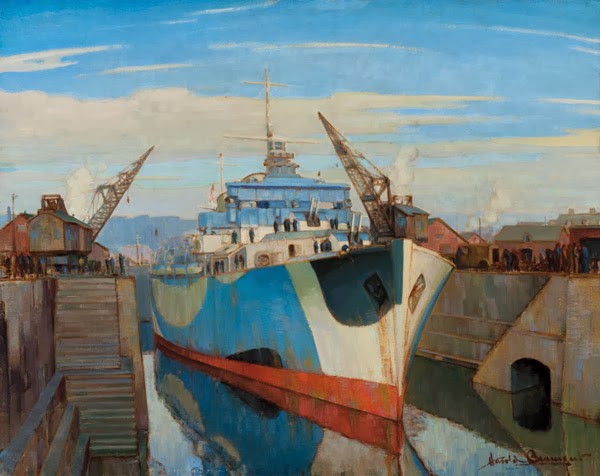
HMCS Prince Robert in Drydock (n.d.)

Thomas Beament Was born in Ottawa. During WW I he served in the RCNVR as an ordinary seaman, then was promoted to warrant officer. Following the end of the war he returned to Osgoode Hall and completed his studies to became Barrister-at-law (1922). The same year he attended evening classes at the Ontario College of Art, Toronto. He Continued serving with the peacetime Naval Reserve, was promoted to the rank of officer in 1924 and finally Lt.-Commander, Mtl. RCNVR Division in 1930.

HMCS Iroquois (n.d.)

At the outbreak of WW II, Beament entered full-time service with the RCNVR, as a ship commander on North Atlantic patrols for three years, rose in rank to Commander (1943); then as official Canadian war artist going back to sea to paint scenes: in the Mediterranean; on convoy in the North Atlantic; in Newfoundland; making a visual record of assault landings and minesweeping duties in the English Channel. The Canadian War Museum has some 76 paintings by him.

Motor Torpedo Boats Leaving for Night Patrol off Le Havre (1945)


A Collection Of Naval Art Decorated the Chambers of the Speaker of the Senate for the Canadian Naval Centenial. You can view that collection at http://www.parl.gc.ca/About/Senate/WorkofNavalArt/index-e.html.

All Works above Are part of the Beaverbank Collection of War Art at the Canadian War Museum

HMCS Bras D’or (FHE 400)

HMCS Bras d’Or (FHE 400) was a hydrofoil that served in the Canadian Forces from 1968 to 1971. During sea trials in 1969, the vessel exceeded 63 knots (117 km/h; 72 mph), making her the fastest warship in the world.


The vessel was built from 1960 to 1967 for the Royal Canadian Navy, as a project for the testing of anti-submarine warfare technology on an ocean-going hydrofoil. Changes in priorities and cost overruns later led to the project’s cancellation. HMCS Bras d’Or (FHE 400) was the second vessel to bear that name (see below) and was built at Marine Industries Limited (MIL) in Sorel, Quebec, the primary contractor being de Havilland Canada, an aircraft company

The ship was saved and donated to the Musée Maritime du Québec at L’Islet-sur-Mer, Quebec. Bellow are photos from my visit in 2006.

IMG_9364IMG_9375IMG_9376IMG_9377IMG_9378IMG_9379
IMG_9380IMG_9381IMG_9382IMG_9383IMG_9384IMG_9385
IMG_9386IMG_9387IMG_9388IMG_9389IMG_9390IMG_9391
IMG_9392IMG_9393IMG_9394IMG_9395IMG_9396IMG_9397
HMCS BrasDor, a set on Flickr.

For Additional Photos Of her running, See this Link

Happy Birthday HMCS Haida

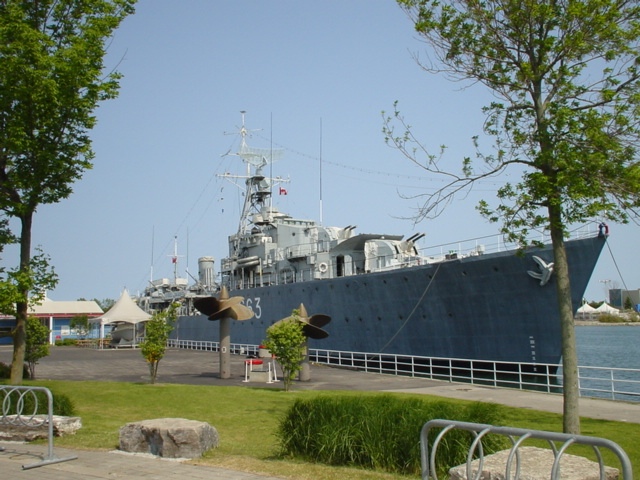
HMCS Haida is a Tribal class destroyer that served in the RCN from 1943-1963.
Haida sank more enemy surface tonnage than any other Canadian warship. She is also the only surviving Tribal-class destroyer out of 27 vessels that were constructed between 1937-1945 for the RN, RAN and the RCN.
She was commissioned Aug 30 1943, and just celebrated her 70th birthday. She is now operated by Parks Canada in Hamilton Ont. 


I visited her when she was in Toronto in 2002. You can see all the photos from that trip here http://www.flickr.com/photos/hfxshippingnews/sets/72157633272248780/
HMCS HaidaDSC00583DSC00584DSC00585DSC00586DSC00587
DSC00588DSC00589DSC00590DSC00591DSC00592DSC00593
DSC00594DSC00595DSC00596DSC00597DSC00598DSC00599
DSC00600DSC00601DSC00602DSC00603DSC00604DSC00605
HMCS Haida, a set on Flickr.

the SS Royal William


SS Royal William was a Canadian steamship that is sometimes credited with achieving the first crossing of the Atlantic Ocean to be made almost entirely under steam power, using sails only during periods of boiler maintenance

She was commissioned by brewer John Molson and a group of investors, built in Cape Blanc, Quebec by John Saxton Campbell and George Black she was launched on 27 April 1831. The steam engines were made and installed in Montreal. She made several trips between Quebec and the Atlantic colonies in 1831. Her owners decided to sail her to Europe and find a buyer. She departed from Pictou, Nova Scotia on 18 August 1833 with seven passengers, a small amount of freight and a load of coal and arrived at Gravesend on the River Thames after a 25-day passage.

 Royal William was eventually sold to the Spanish Navy where she served for many years and earned the distinction of being the first steamship to fire a shot in anger during a minor Spanish rebellion.

One of Royal William’s co-owners was Samuel Cunard a merchant from Halifax Nova Scotia who drew important lessons from the ship which he applied when he founded the Cunard Steamship Company a few years later.

Happy 100th Acadia

 Today marks the 100th anivarsary of the Launching of the CSS Acadia. The Acadia is a  former hydrographic Canadian Survey ship of the Canadian Government, that is now part of the collection of the Maritime Museaum of the Atlantic.

Acadia served Canada for more than five decades from 1913–1969, charting the coastline of almost every part of Eastern Canada including pioneering surveys of Hudson Bay. She was also twice commissioned into the Royal Canadian Navy as HMCS Acadia, during the 2 world wars.

Retaining her original engines, boilers and little-changed accommodations, she is one of the best preserved Edwardian ocean steamships in the world and a renowned example of Canada’s earliest scientific prowess in the fields of hydrography and oceanography.